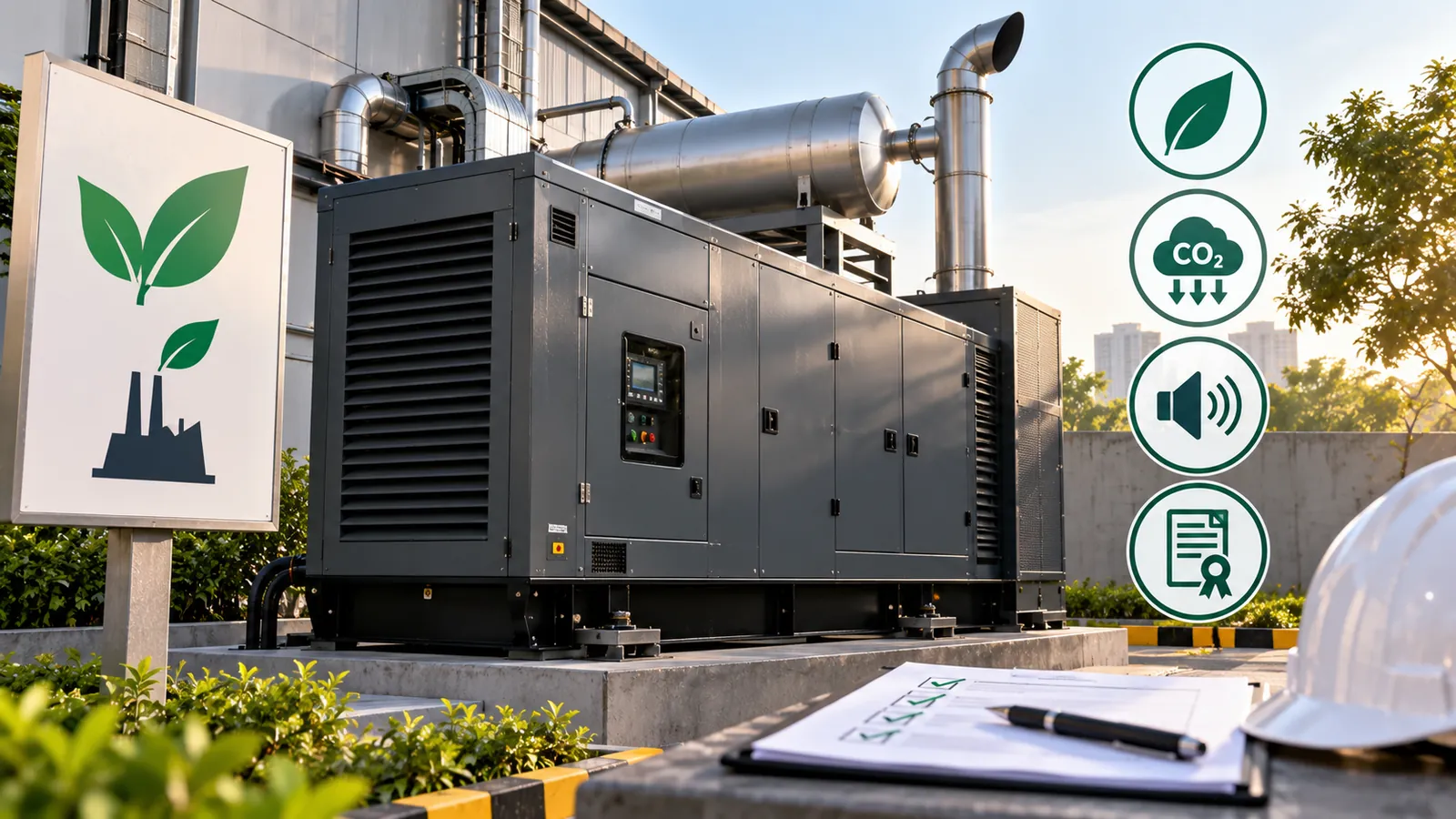
CPCB IV+ is the common industry name for India's revised emission-control framework for new generator-set engines. The official framework comes from the Environment (Protection) Rules and CPCB's compliance procedure, not from the marketing label alone.
Meaning, scope and context
The Ministry of Environment, Forest and Climate Change notification G.S.R. 804(E), dated 3 November 2022, revised emission standards for new internal-combustion engines used in power-generating sets. CPCB's published system and procedure covers engines up to 800 kW gross mechanical power and includes specified compression-ignition, positive-ignition and fuel configurations.
The rules address air pollutants through power- and engine-category requirements. Generator noise is governed through separate environmental noise provisions and product/site arrangements. Do not assume that an engine emission certificate alone proves the complete installed genset is compliant.
Applicability
Applicability depends on the engine's manufacture or supply context, power category, fuel and configuration. Transitional amendments existed for qualifying earlier purchase orders; those dates should not be applied to a 2026 purchase without checking the current notification and vendor evidence. Existing sets may also face separate operating, consent, retrofit or local directions.
Who is responsible for what?
Manufacturer, importer or supplier
They should ensure the model is covered by the applicable type-approval and conformity-of-production process, supply the exact approved configuration and provide required labels, certificates, manuals and records.
Buyer and site owner
Procurement should specify the applicable regulatory stage and obtain model-specific documents before dispatch. The owner should verify engine and genset identifiers, approved after-treatment, acoustic enclosure, exhaust arrangement, consent or authority conditions, and responsibilities for commissioning and warranty.
Operator and maintenance team
Operate within manufacturer instructions, use the specified fuel and consumables, keep after-treatment and acoustic systems intact, record operating hours and maintenance, investigate warnings, and preserve evidence for inspections.
Documents, installation and operation
- Purchase specification, invoice, model and serial-number records.
- Applicable type-approval or compliance documents for the supplied configuration.
- Manufacturer installation, fuel, lubricant and maintenance instructions.
- Commissioning results, settings, drawings and training records.
- Consent, permission or local authority documents where applicable.
- Operating-hour, service, fault and replacement-part history.
Installation should follow manufacturer requirements for ventilation, cooling, exhaust back-pressure, safe clearances, fuel storage, electrical protection, earthing, fire safety, drainage and maintainability. Unapproved changes to the engine, controls or after-treatment can compromise emissions and certification.
Older stages versus CPCB IV+
CPCB IV+ represents a later, more stringent and broader technical framework than the commonly called CPCB II stage. The practical difference is not a universal retrofit kit or one emission number: approved technology, test procedure and limits vary by power and engine category. Compare the exact official category and supplied certificate rather than relying on a dealer's shorthand.
Official sources and verification
- CPCB system and procedure for revised genset emission standards.
- CPCB generator-set noise information.
Source review date: July 28, 2026. Confirm the latest gazette notifications, CPCB procedures, state pollution-control board directions and site consent conditions before procurement or compliance decisions.
Frequently asked questions
What is a CPCB 4 genset?
It is a common shorthand for a genset using an engine covered by the revised framework commonly called CPCB IV+. Compliance should be verified from official documents for the exact model and category.
Does CPCB IV+ apply to every existing generator?
Not in one identical way. Manufacture and supply dates, engine category, existing-set directions, consent conditions and local requirements must be checked.
Is an emission certificate enough?
No. Verify the exact supplied configuration, installation, acoustic and exhaust arrangements, operating requirements, records and applicable site approvals.
Related guidance and services
For site-specific support, see our generator compliance services.