
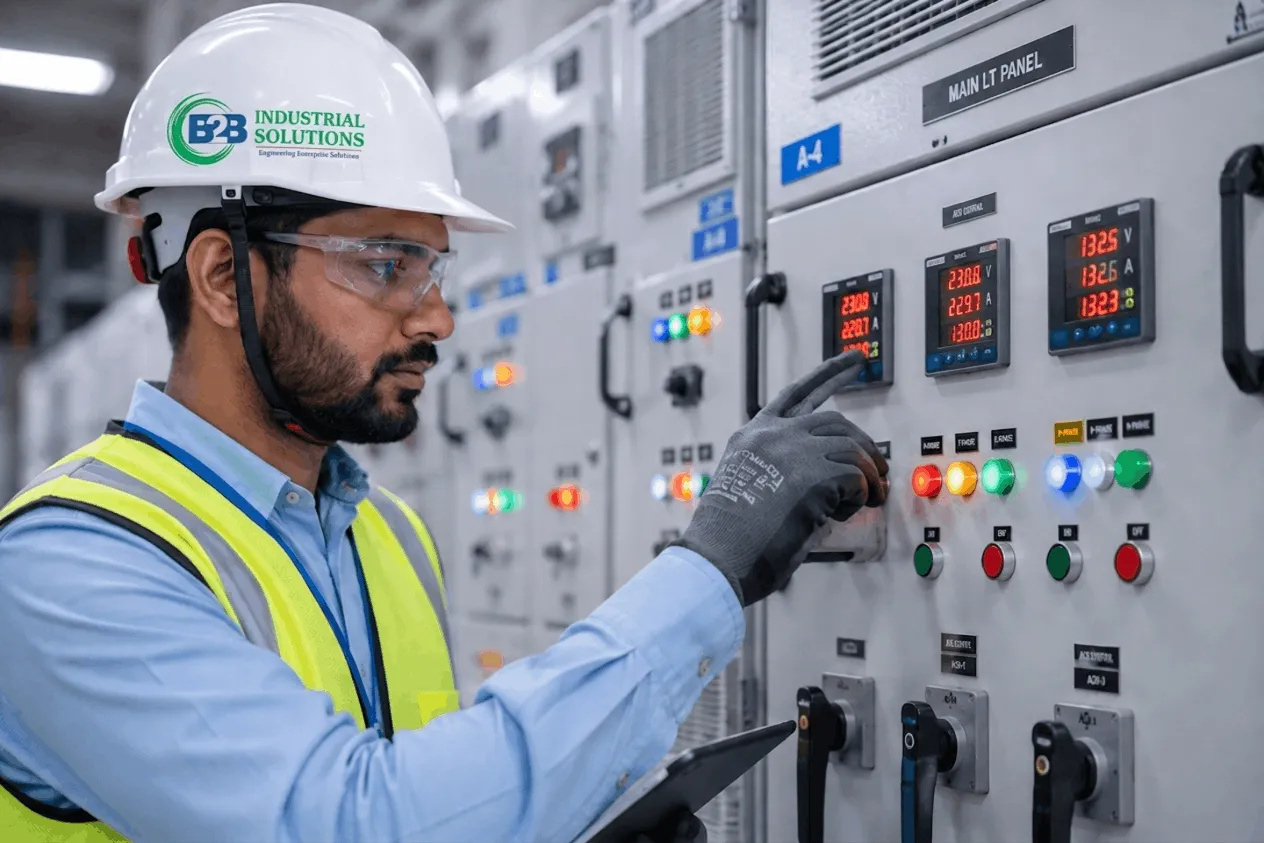
What is an Electrical Safety Audit (ESA)?
An Electrical Safety Audit (ESA) is an exhaustive, systematic evaluation of an industrial facility’s entire electrical infrastructure-from the high voltage (HT) switchyard and step-down transformers down to the low voltage (LT) distribution panels, motor control centers (MCC), earthing pits, and end-use machinery. More than 40% of all major industrial fires in India are traced back to electrical faults such as short-circuits, overloading, loose terminations, and severe harmonic distortions. An ESA actively detects these hidden anomalies before they trigger catastrophic downtime or fatal industrial accidents.
At B2B Industrial Solutions, our electrical engineering veterans deploy advanced NABL-calibrated diagnostic tools like thermal infrared imagers and power quality analyzers. We don’t just “inspect” panels; we load-test, thermally scan, and analytically verify that your critical power infrastructure is inherently safe and capable of handling future production scale-ups.
Why Your Industry Needs an Electrical Safety Audit Now
Modern manufacturing requires complex automation, variable frequency drives (VFDs), and heavy non-linear loads. These configurations stress aging electrical grids in ways standard fuses and MCBs often fail to protect against.
- Disaster Prevention: Pre-emptively detect loose, oxidized, or rapidly degenerating connections that cause silent heating and eventual arc flashes.
- Statutory Compliance: Satisfy mandatory requirements by the local State Electricity Inspectorate and the Central Electricity Authority (CEA) guidelines.
- Business Continuity & Uptime: Prevent unforeseen, multi-hour power outages caused by unexpected transformer trips or main incomer failures.
- Insurance Mandates: Many leading industrial insurers require annual or biennial electrical thermal scanning and safety reports to validate fire insurance premiums.
Relevant Indian & International Standards
Our ESA procedure is governed by rigorous engineering and safety regulations, ensuring your facility passes any external regulatory scrutiny:
- CEA Regulations 2010: Central Electricity Authority measures relating to safety and electric supply.
- IS 732: Code of practice for electrical wiring installations.
- IS 3043: Code of practice for earthing and advanced grounding infrastructure.
- Indian Electricity (IE) Rules 1956: Pertaining to general industrial safety margins and clearance zones.
- NFPA 70E: International standard for electrical safety in the workplace, covering arc flash boundary analysis.
Our Proven 7-Step ESA Process
Industries Served Nationwide
Because electrical physics doesn’t discriminate, we are called upon to secure varied verticals:
Case Study: Critical Chemical Processing Plant
Challenge: A highly volatile chemical plant in Gujarat was experiencing frequent, unexplained tripping of their main process pumps, severely risking a runaway reaction.
B2B Industrial Solution: Deployed a specialized Electrical Safety & Power Quality Audit. Thermography revealed extreme localized heating (142°C) inside the primary MCC busbar chamber due to severe harmonic resonance and loose oxidized aluminum terminations.
Results Delivered:
- Immediately isolated the load and supervised emergency re-termination using bi-metallic lugs.
- Designed and integrated an active harmonic filter, eliminating the resonance.
- Zero unwarranted trips logged over the next 24 months of continuous operation.
Cities We Serve
Operating out of Gurgaon, our rapid-response electrical engineering teams travel swiftly across Delhi, Noida, Faridabad, Manesar, Pune, Mumbai, Ahmedabad, Chennai, Bangalore, and fully comprehensive Pan-India operations. Serious electrical hazards require immediate expertise.
Frequently Asked Questions (FAQ)
1. Does an electrical safety audit require a total plant shutdown?
No. In fact, thermography and power quality analyses are most effective when the plant is running at 70-100% operational load. We only request brief, scheduled shutdowns if we identify a critical, imminent danger that requires immediate physical intervention.
2. What is Electrical Thermography?
Thermography involves using advanced infrared cameras to photograph electrical panels. It exposes loose connections, overloaded phases, and deteriorating insulation by displaying massive differences in heat signatures.
3. Will you check the physical earthing pits?
Yes. Core ESA protocol mandates that we measure the earth pit resistance using fall-of-potential megger testing, ensuring it stays well below the IS:3043 statutory limits (generally below 1 ohm for transformers, 2 ohms for regular body earth).
4. If you find a safety fault, do you help fix it?
As a turnkey engineering firm, B2B Industrial Solutions maintains specialized execution teams. We immediately deploy technicians for cable-laying, busbar modification, MCC rewiring, and APFC panel installations to rectify the flagged risks.
5. Why are our neutral cables getting so hot?
Overheated neutral phases are typically the result of severe phase-unbalance or high 3rd-order harmonic currents generated by non-linear loads like VFDs or computer clusters. Our audit will identify the specific source and recommend active filtering.
6. How often should we conduct an ESA?
General manufacturing facilities should conduct a full ESA once every 12 to 24 months. Critical facilities like data centers, specialized hospitals, and chemical processing plants require it every 6 to 12 months.