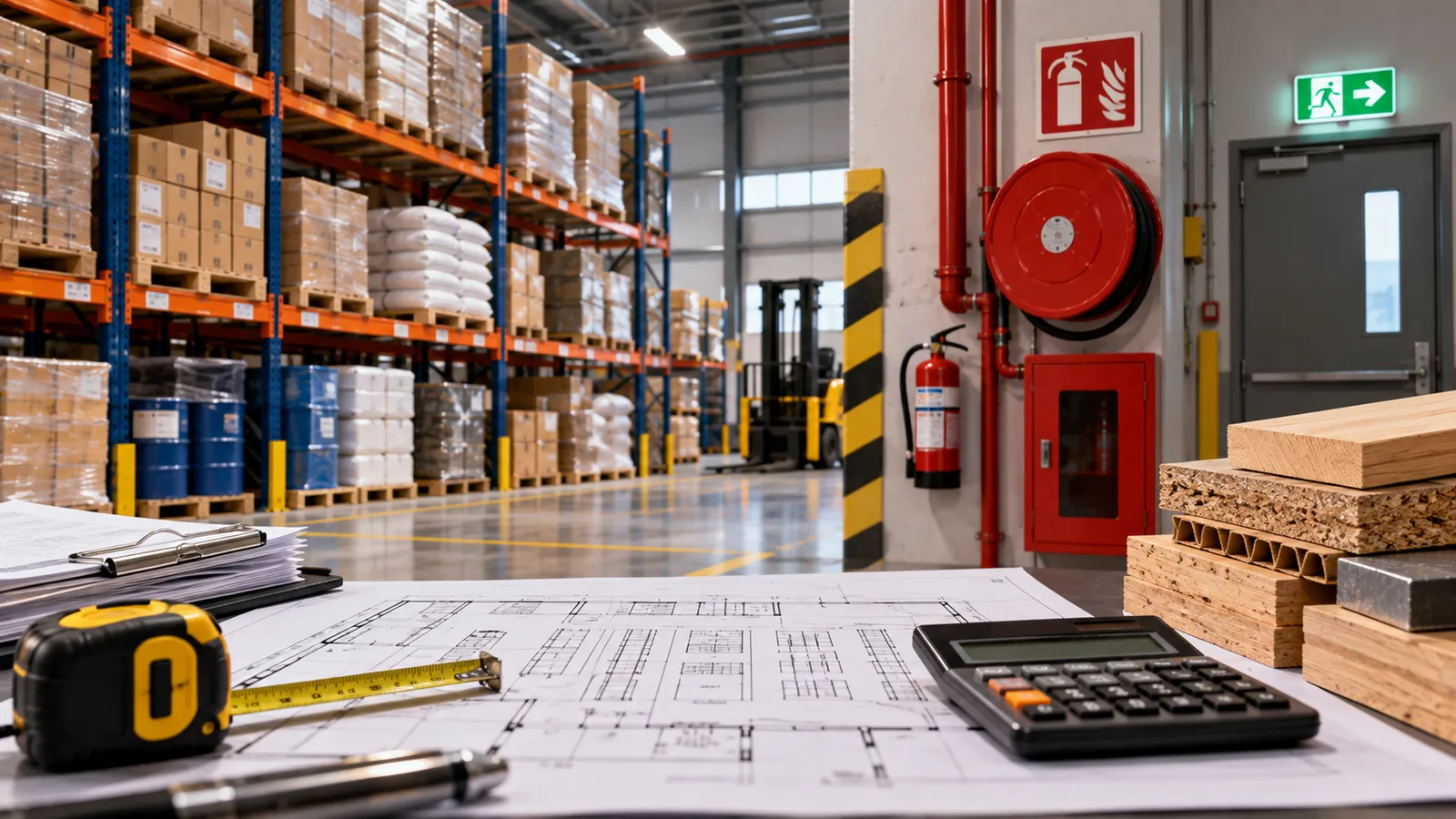
Fire load is the potential heat energy from combustible materials in a space. Fire-load density expresses that energy per unit of floor area, commonly in megajoules per square metre (MJ/m²).
Fire-load density formula
Fire-load density (MJ/m²) = Σ [mass of each combustible material (kg) × net calorific value (MJ/kg)] ÷ floor area (m²)
The summation sign means calculate the heat contribution of each combustible material and add the results. Use consistent units. The calculation is different from an assessment of ignition probability, fire growth, ventilation, compartmentation, suppression or occupant risk.
Basic calculation method
- Define the fire compartment or assessment area and measure its floor area.
- Inventory fixed and movable combustible materials, including packaging, stored goods, finishes, furniture, cable insulation and process materials.
- Estimate or measure the mass of each material.
- Obtain a defensible net calorific value from reliable material or test data.
- Multiply each mass by its calorific value, add the heat energy, then divide by floor area.
- Document assumptions, exclusions, occupancy changes and uncertainty.
Numerical example
Consider a 100 m² room containing 500 kg of paper products at an assumed 16 MJ/kg and 200 kg of timber at an assumed 18 MJ/kg. The paper contributes 8,000 MJ and timber contributes 3,600 MJ. Total potential heat is 11,600 MJ.
Educational estimate: 11,600 MJ ÷ 100 m² = 116 MJ/m².
The assumed calorific values are illustrative, not universal product values. A formal study should use data appropriate to the actual materials and account for the assessment method required by the project or authority.
Data collection and limitations
Inventory quality usually drives result quality. Palletised stock may change daily; composite goods contain several materials; liquids need density and heat data; inaccessible voids can hide combustible insulation or cabling. Record the survey date, maximum credible stock and evidence used.
A simple total does not describe how quickly a fire can develop, smoke toxicity, burning behaviour, ventilation, fire resistance, detection, suppression, travel distance or emergency response. Do not use this example alone to select structural fire resistance, extinguishing systems or legal compliance.
When a professional fire assessment is needed
Use a qualified professional where the result informs building design, fire compartmentation, insurance, hazardous storage, authority approval, high-piled storage, process safety or material changes. A professional study should define the governing code or authority criteria and reconcile the calculation with the building and operating conditions.
This page explains the arithmetic. It does not replace a building survey, code review, fire engineering analysis or authority approval.
Frequently asked questions
What is fire-load density?
It is the potential heat energy of combustible contents divided by the relevant floor area, commonly expressed in MJ/m².
Does a low fire-load number prove a building is safe?
No. Fire safety also depends on ignition, layout, ventilation, compartmentation, detection, suppression, evacuation and response.
Can this example be used for authority approval?
No. It is educational. Formal decisions should use the applicable method, actual survey data and a qualified professional.
Related guidance and services
For site-specific support, see our professional fire-load study services.