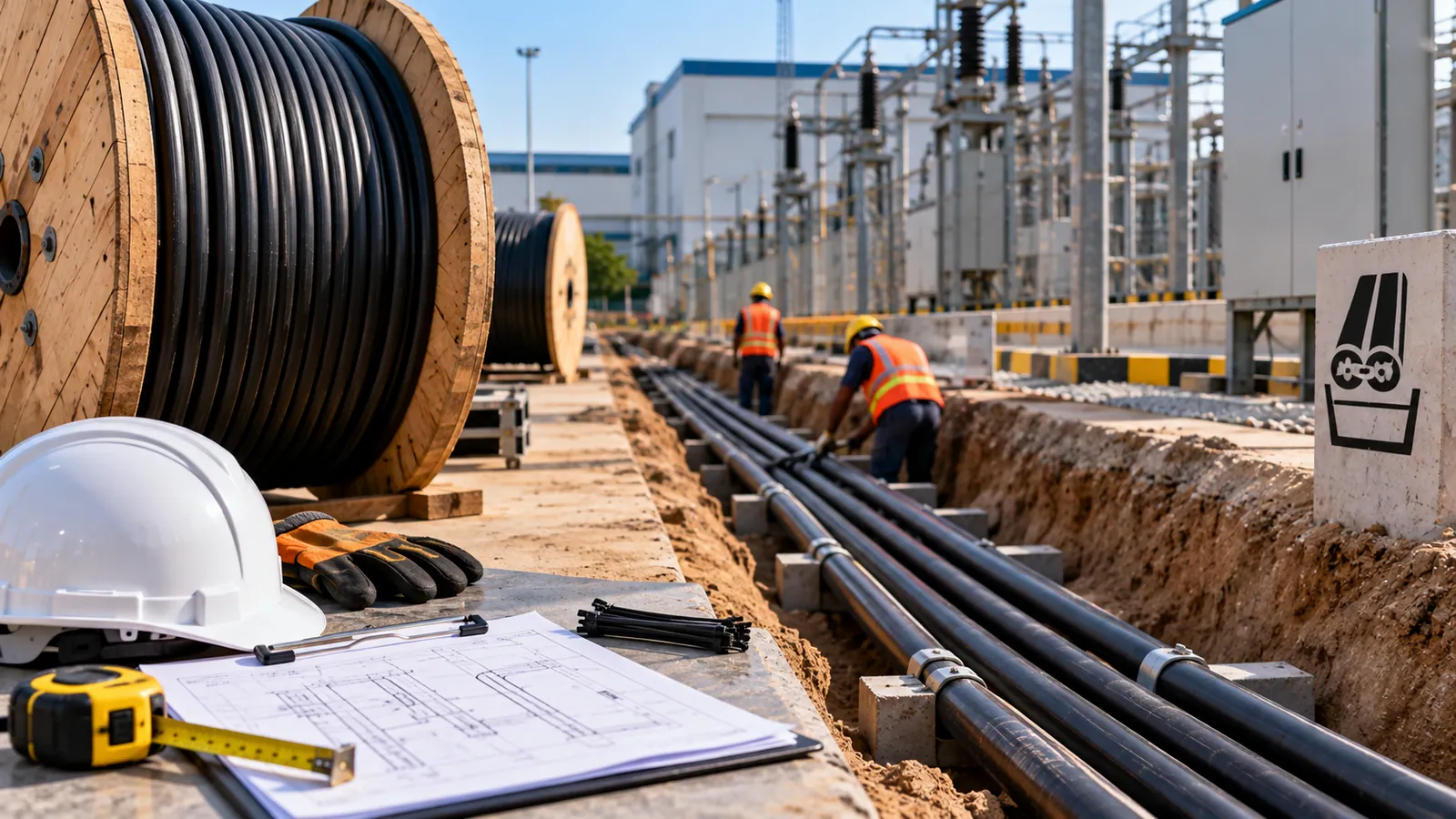
IS 1255 is the Indian code of practice for installation and maintenance of power cables up to and including 33 kV. It gives broad guidance for selection, transport, laying, jointing, termination, testing, commissioning, maintenance and fault localisation.
Scope and planning
IS 1255 provides general installation and maintenance guidance for relevant power cables up to 33 kV. It does not replace project drawings, cable and accessory manufacturer instructions, contractual specifications or regulations for special applications.
Before work, confirm the cable schedule, route, installation method, drum lengths, joint locations, pulling direction, compatible accessories, permissible pulling tension and bending radius. Plan crossings, thermal conditions, segregation, earthing, fire stopping and future access.
Receipt, storage and cable-drum handling
- Check drum number, cable type, voltage grade, length, damage, end caps and test documentation on receipt.
- Keep cable ends sealed against moisture and contamination.
- Store drums upright on firm, drained ground and chock them against movement.
- Move and roll drums only in the indicated direction and with suitable lifting equipment; do not drop them.
- Protect stored cable from impact, water, excessive heat, chemicals and unauthorised handling.
Route preparation and cable pulling
Trenches and supports
Prepare the route before pulling. Trenches should be stable, drained and free of sharp objects, with the specified bedding, cover, markers and mechanical protection. Trays, racks and cleats should be suitable for cable mass, short-circuit forces, environment and required spacing.
Pulling, bending radius and separation
Use manufacturer-approved pulling grips, rollers, lubricant and monitoring. Keep tension and sidewall pressure within approved limits, avoid twists and kinks, and maintain the specified minimum bending radius during and after installation. Required separation depends on voltage, circuit arrangement, heat dissipation, electromagnetic effects and project rules; use the design rather than a guessed universal distance.
Identification, termination and testing
Identify circuits and phases at accessible points and both ends. Confirm cable ends remain clean and dry. Jointing and termination should be performed by competent people using accessories matched to cable construction and voltage, with controlled preparation and torque.
Inspect the completed route and carry out the tests specified by the current standard, project and manufacturer before energisation. Record cable and drum details, route, joints, test equipment, results, date and responsible person.
Safety and maintenance
Control excavation, lifting, stored drum energy, manual handling, traffic, work at height and electrical isolation. Before maintenance, identify the correct circuit, isolate, lock out, prove dead, discharge and earth as required by the safe system of work.
Maintain route markers, covers, supports, seals, fire stops, earthing and records. Investigate overheating, sheath damage, moisture, repeated protection operation or abnormal test trends rather than simply returning the circuit to service.
Use the current official standard
The BIS preview of IS 1255 confirms its general scope. This article intentionally does not reproduce protected clauses, tables or detailed requirements.
Source review date: July 28, 2026. Consult the current official standard, project specifications, cable and accessory manufacturer instructions, and a qualified electrical engineer before design or installation.
Frequently asked questions
What does IS 1255 cover?
It gives broad guidance for installation and maintenance of power cables up to and including 33 kV, including handling, laying, jointing, testing and maintenance.
Does IS 1255 give one bending radius for every cable?
No. The applicable radius depends on cable construction, size, installation condition, current standard and manufacturer requirements.
Can this article replace IS 1255?
No. Use the current official standard, project specification and manufacturer instructions with competent engineering supervision.
Related guidance and services
For site-specific support, see our power cable laying services.