
What is Harmonic Analysis?
A pure electrical supply flows in a perfect 50 Hz sine wave. However, modern industries use non-linear loads (Variable Frequency Drives, LEDs, PLCs, Arc Furnaces, and UPS systems) which draw current in abrupt pulses rather than smooth waves.
These pulses inject “Harmonics” — multiple frequencies (150Hz, 250Hz, 350Hz) that distort the core power supply.
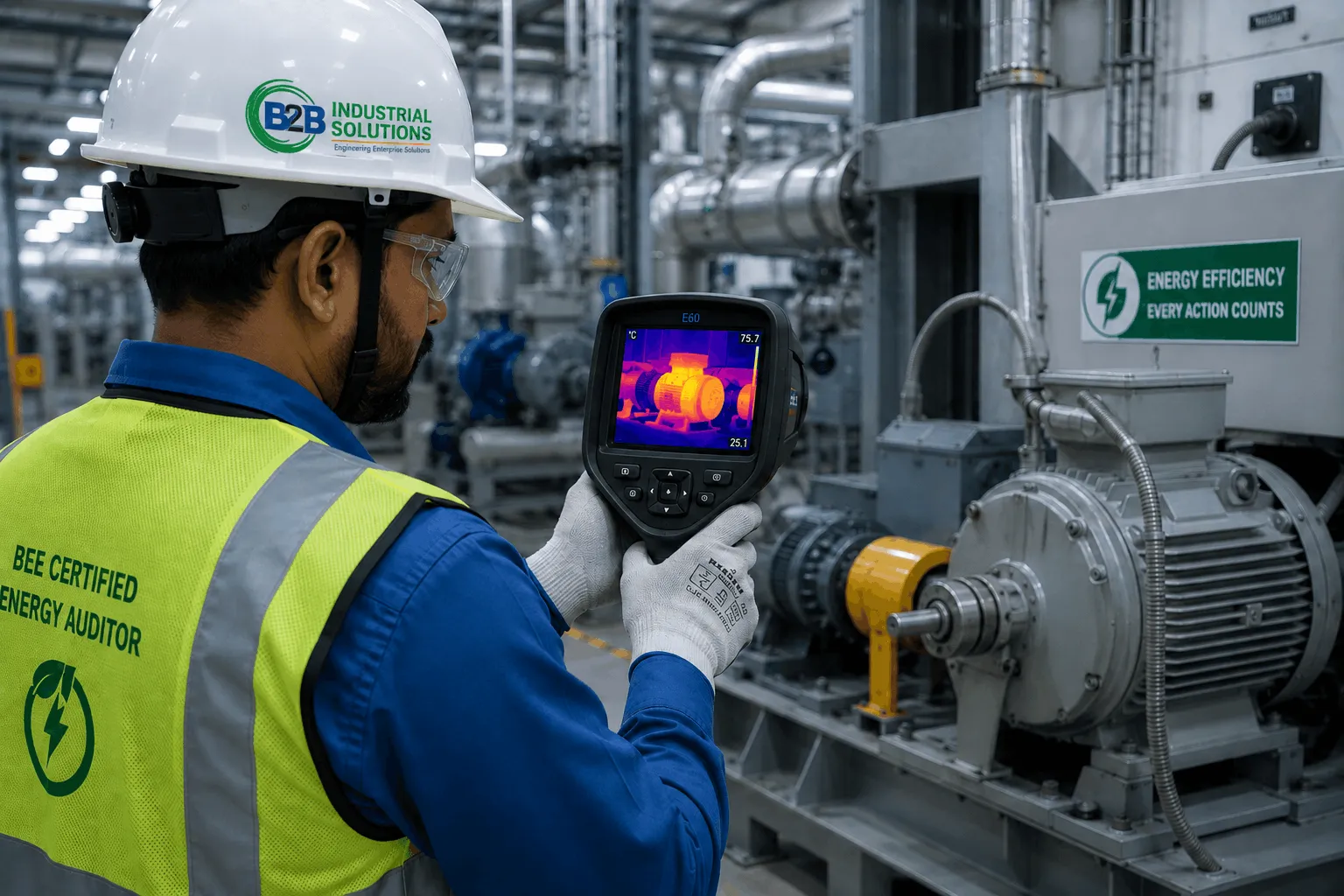
B2B Industrial Solutions uses advanced Power Quality Analyzers to measure Total Harmonic Distortion (THD). We mathematically analyze these injected frequencies and design tuned capacitor banks or Active Harmonic Filters (AHF) to cancel out the interference, returning your grid to a pristine sine wave.
Why Your Industry Needs Harmonic Mitigation Now
Excessive harmonics generate severe internal heat, causing transformers to derate and capacitors to explode via resonance.
- Prevent Capacitor Explosions: If you install raw capacitors (APFC) into a highly harmonic grid, they will act as a sink, overheat, and fail violently.
- Protect Neutral Wires: Triplen harmonics (3rd, 9th) sum up in the neutral wire. We frequently see neutrals melting down and causing fires because they were sized only for the phase current, not the harmonic sum.
- Avoid Grid Penalties: Dis-coms monitor point of common coupling (PCC) distortion. Injecting dirty power back into the grid results in steep financial penalties.
Relevant Indian & International Standards
- IEEE-519 (2014): The benchmark global standard for defining acceptable harmonic mitigation parameters.
- Central Electricity Authority (CEA): Sets limits on maximum THD-V (voltage distortion) permissible.
Our Proven 7-Step Harmonic Process
Industries Served Nationwide
Cities We Serve
Gurgaon, Delhi, Noida, Pune, Mumbai, Ahmedabad, Chennai, Hyderabad, Pan-India.
Frequently Asked Questions (FAQ)
1. What's the difference between Active and Passive harmonic filters?
Passive filters use tuned capacitors and inductors to block specific harmonic frequencies (e.g., 5th order). Active Harmonic Filters (AHF) use rapid power electronics to inject equal and opposite inverse currents, cancelling out a broad spectrum of harmonics dynamically in real-time.